







Gucci is far from the first brand to use AI-generated images in its marketing. It’s surprising that they didn’t learn from the Coca-Cola backlash of November 2025. Coke’s annual holiday commercial was poorly received by viewers, who called it “soulless.” Not only that, but it allowed their direct competitor, Pepsi, to dunk on them a few months later! Pepsi’s retort was titled, rather pointedly, “The Choice.” In a CGI video directed by Oscar winner Taika Waititi, a polar bear (the Coke mascot) chooses Pepsi over Coke. “You deserve taste,” the ad proclaims, as if to say that good taste doesn’t involve using AI-generated content that people don’t even like.
AI-generated media is already beyond gauche. And Gucci has fallen for the hype of AI, failing to realize that a lot of folks simply find it distasteful.
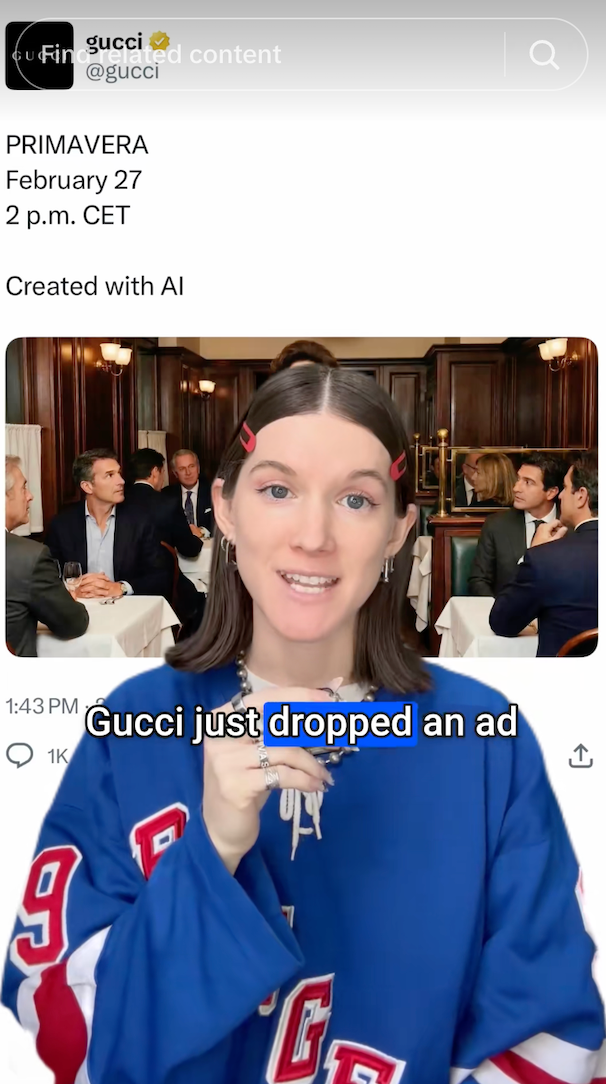
TikToker @boysclubworld discussing the Gucci ad
Pew research from September 2025 found that 53% of the people they polled think that AI usage will make it harder to think creatively. A majority of the respondents also thought that AI will hinder decision-making and problem-solving, and make it harder to form meaningful relationships with other people. Most people don’t think AI will bring positive outcomes, and why would they? We already know that AI is taking jobs away from the skilled professionals who really need them. We don’t like AI art or AI video slop, because it comes across as deceitful. And yet, AI is everywhere.
Commenters on one of Gucci’s AI-generated photos came in hot with the critiques: “You did not need to use AI for this, so tacky,” said one Instagram user. “Ai slop or GTA collab,” joked another commenter, gaining more than 4,300 likes on the comment. “How to Ruin Your Brand Image (Speedrun),” wrote another. The longer you scroll through the comments, the more you’ll see confusion (“Is this a joke?”) and people denoting the cheapness of the stunt (“Gucci from Wish”). “Any luxury brand that uses AI should not be considered luxury anymore,” one person wrote, and 573 people agreed enough to like that comment. This comment really hit the nail on the head: “You’re unwilling to invest in your own brand, but expect your customers to? Yikes 😂.” A lot of the critiques compared the pictures to Grand Theft Auto, but even that video game was created by human beings, unlike this ad.
Like it or not, Gucci, and other brands who use AI, are taking a stance. They’re picking a side in the growing choice to use AI-generated materials. Sure, using AI may feel like a hip, techno-savvy thing to do for brands right now, but the implications are unflattering. When a brand uses AI-generated materials, they’re presumably not paying artists, script writers, editors, videographers, etc. Fashion house Gucci probably didn’t even pay a stylist to craft their literal fashion advertisements.
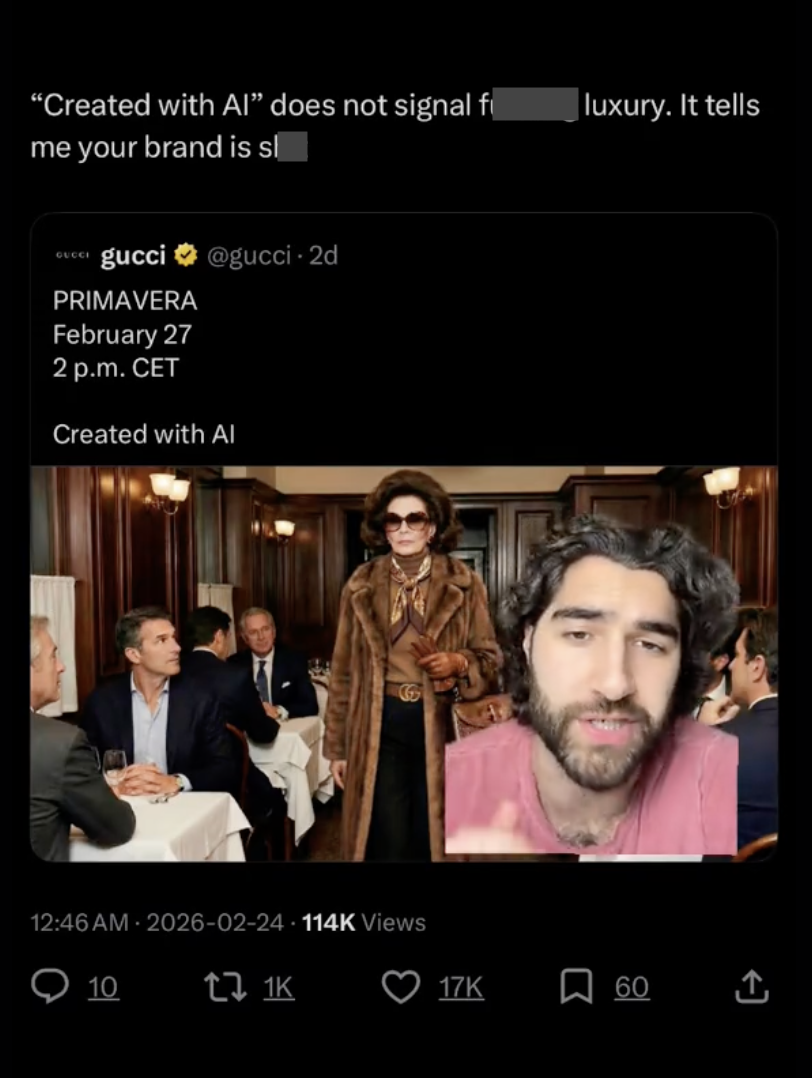
TikToker @bahador.jpg discussing the Gucci ad

If a brand can’t even be bothered to put their clothing on a person, why would any human bother to clothe themselves with that brand? Brands have forgotten that the entire point of advertising is to show people enjoying the product in the hopes that customers will project their own wants and needs onto the ad and purchase the item. And when you’re selling fashion at a high price point, you never want to be accused of looking cheap. So Gucci’s decision to use AI is a real head-scratcher.
The brand opens itself up to any competitor who wants to take shots. I have no doubt that we’ll see brands like Versace, Prada, Valentino, Bottega Veneta, or Louis Vuitton going to great lengths to highlight how uncool Gucci’s ad campaign is. Other high-fashion houses are, no doubt, putting their heads together to create human-made advertisements to capitalize on that backlash. They’ll probably win that fight, too! Humans are endlessly creative. AI consists of plagiarized works, incapable of creating anything truly new or unique.
Photo via Dima Pechurin for Unsplash+
If AI-generated content was a money printer for every human being, we’d all be thrilled to use it. But brands are missing the point here. Most people are being negatively impacted by AI, and not seeing any benefits from it. Bringing AI-generated materials to the table is already being considered a party foul by society. Just because you can do something, doesn’t mean you should.
The tech folks spend a lot of time and money fretting over AI’s potential. The actual results are almost always disappointing. The solution for using generative AI for creative projects can be boiled down to two words: Stop it. Just don’t use AI-generated material. You won’t be a luddite for refusing to use tech that doesn’t bring optimal results to the table. We tried things like the Metaverse and NFTs, which were also promised to be the tech of the future, and it just didn’t take off. These were also products that didn’t deliver the pie-in-the-sky dreams they promised. You won’t be called anti-tech for not using products like that, which don’t meaningfully benefit their users. However, brands might have to learn this the hard way.
I have high hopes for the future of this, though. People need to work, our starving artists are really starving these days! There is a real hunger for quality content. The slop-pocalypse of valueless AI-generated content isn’t what most people desire. And that leaves us with the main thing that tech-forward executives aren’t considering: The potential of people, not the tech that’s plagiarising them. I can’t imagine Gucci is thrilled about the reception of this, nor was Coca-Cola happy about the reaction to their own AI-ad mishaps. It’s going to be too easy for these brands to get dunked on by their competitors, and it’s up to every company to figure out their own risk-tolerance for allowing AI in their content. I have faith that companies will reject their AI-curious ideas, and instead, give the customers what they actually want: Humanity.
Like what you see? Follow Us and Add Us as a Preferred Source on Google.